


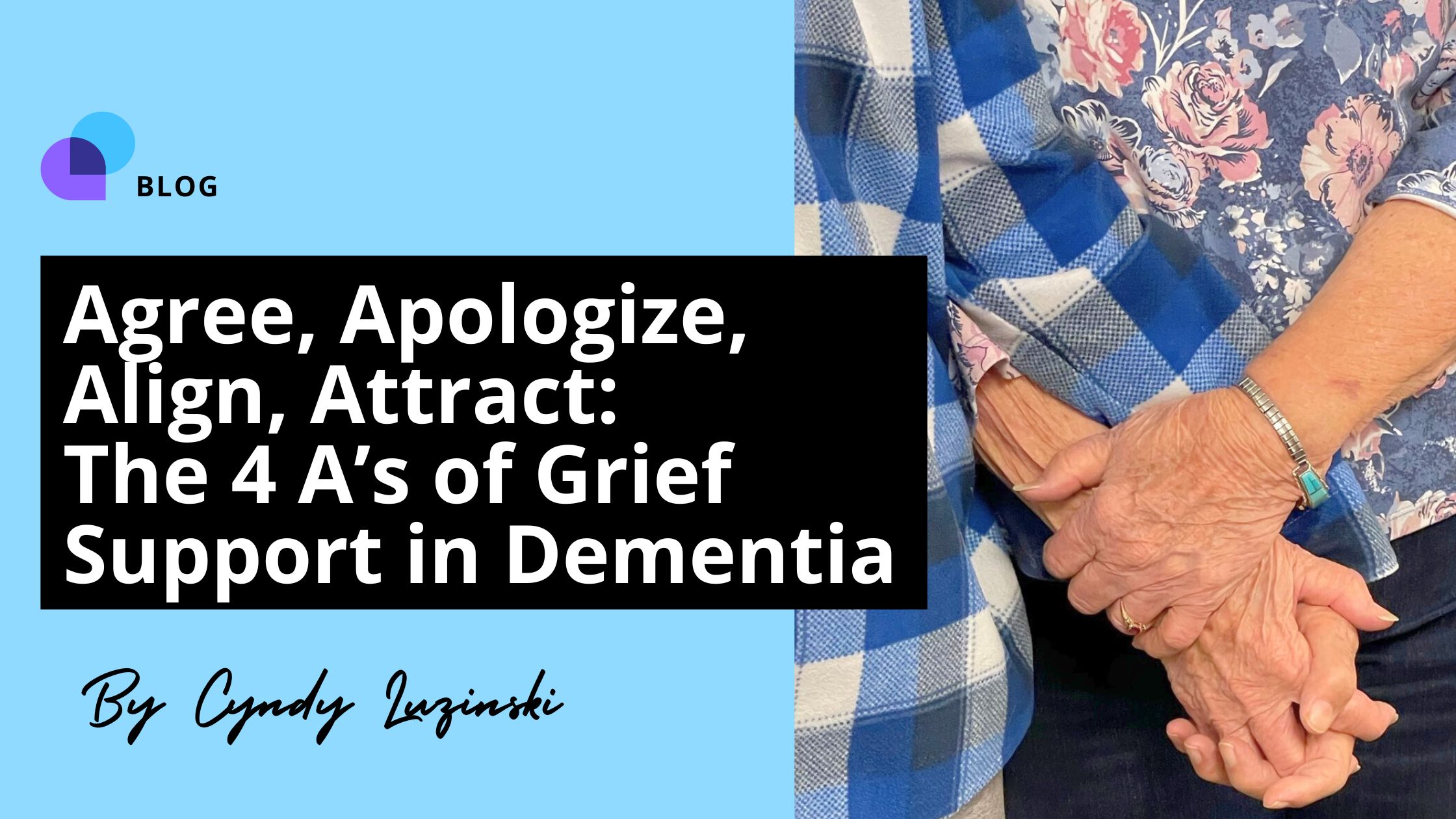
26 Aug Agree, Apologize, Align, Attract: The 4 A’s of Grief Support in Dementia
Posted at 13:24h
in Blog
Helen has been married to Frank for 63 years. They had no children, but they had a deep, steady love — the kind you could feel when you walked into the room. Two weeks ago, Frank died.
Frank, knowing Helen lived with dementia, had planned for in‑home care to continue after he passed. But now, friends are worried. The helpers stop by, but the support isn’t enough to keep Helen safe, engaged, or comforted.
And Helen knows. Despite her dementia, she feels Frank’s absence. She misses him — acutely, every day. It’s heartbreaking for her and her friends. One of Helen’s friends called us at Dementia Together for guidance. We discussed practical, specific logistics and the broader question we are often asked:
How do you help someone with dementia grieve?
How do you help someone with dementia grieve?
Grief and Dementia: Yes, There Is a Way
At Dementia Together, we often say: “What’s good for dementia is good for the world.”
That’s why the communication tools we teach — including those grounded in SPECAL® — don’t just apply to moments of confusion or agitation. They also work in moments of deep loss.
And here’s the good news: there IS a Dementia Together-informed way to support someone through grief.
Our guide comes down to a SPECAL® strategy, “Join the Club” with the follow-up “HOW to Join the Club” guiding principle we created at Dementia Together-the 4 A’s.
If the person living with dementia is in the Missing My Person club, you join the Missing My/Your/Our Person club.
Our goal is not to get them out of their club, get them “over their grief,” convince them it could be worse, or prod them to feel a different way. Our goal is to help them feel secure and loved. Our goal is to ensure they aren’t alone in their Missing My Person club.
Joining the Club with the 4 A’s
Because all behavior has meaning, we know people with dementia aren’t “giving you a hard time” when they express distress — they’re having a hard time. Dementia Together developed a specific application we call The 4 A’s to help in moments of distress:
AGREE — Don’t argue or contradict. Repeat their words; match their emotional tone.
APOLOGIZE — Express empathy: “I’m sorry…”
ALIGN — Communicate, in words or presence, that you are with them in this moment.
ATTRACT — Gently guide toward something comforting or engaging.
Here’s what that looked like with Helen: Agree. Apologize. Align. Attract.
AGREE:
“You miss Frank so much,” matching our tone with hers.
“You miss Frank so much,” matching our tone with hers.
APOLOGIZE:
“I’m so sorry he’s gone.”
“I’m so sorry he’s gone.”
ALIGN:
Sometimes alignment is silent: sitting beside her, hand in hand, letting her feel safe in shared sadness.
Sometimes alignment is silent: sitting beside her, hand in hand, letting her feel safe in shared sadness.
Sometimes, it’s gentle words that bridge grief and love:
“He sure loved you.”
“I’m glad we can be here together, knowing he made sure you’d be cared for.”
“We can be sad together.”
“I’m glad we can be here together, knowing he made sure you’d be cared for.”
“We can be sad together.”
ATTRACT: (to something better)
Once Helen feels understood, we invite memories that bring Frank close without causing new distress:
Once Helen feels understood, we invite memories that bring Frank close without causing new distress:
“I’d love to see your wedding photo — you both look so happy. Tell me about that day.”
“Remind me how you first met him…”
“Remind me how you first met him…”
By doing this, we shift from raw loss to a space where Helen can relive her joy and feel Frank’s presence in a comforting way.
Sometimes Presence Is Enough
Joining the Missing Frank Club may simply mean sitting with Helen, holding her hand, giving her eye contact and a facial expression that conveys empathy, and possibly saying:
“You miss Frank. I’m so sorry he’s not here anymore.” (Agree and Apologize.)
And stopping there. No fixing. No talking her out of her feelings. Just honoring them.
Why This Matters
Grief doesn’t disappear because someone has dementia. In fact, dementia can make the loss both harder to express and harder to soothe, especially if common sense (versus SPECAL® sense) approaches are used. This unfortunately happens too often for people experiencing dementia who may not have an awareness of recent circumstances like Helen demonstrated.
Using the SPECAL® framework, we can understand how people living with dementia may experience distress (that goes unnoticed or unattended) without even knowing why they feel distressed. They haven’t stored recent facts to explain their angst, so they naturally match back to past experiences when they had felt similar distress. They use their matching to give themselves context to explain their current distress. This allows them to take action—to cope and find comfort. The result? Taking action may mean they need to look for the spouse, sibling, or parent who they can’t find (and who may have actually died decades ago), or they grieve the loss of their loved one as if they had just died. Regardless of how the expert living with dementia matches to old experiences in response to their feelings of distress, our moral imperative is to avoid disturbing what makes sense to them—to “humbly defer” with kindness and Join the Club.
“Joining the Club” through the 4 A’s isn’t about denying the loss ever happened — it’s about validating the person’s feelings, connecting with them, and inviting moments of comfort without forcing a change in feeling before they’re ready.
That’s not just good dementia care.
It’s good human care.
It’s good human care.

Written by:
Cyndy Hunt Luzinski, MS, RN, SPECAL® Practitioner
Founder and Executive Director, Dementia Together
