


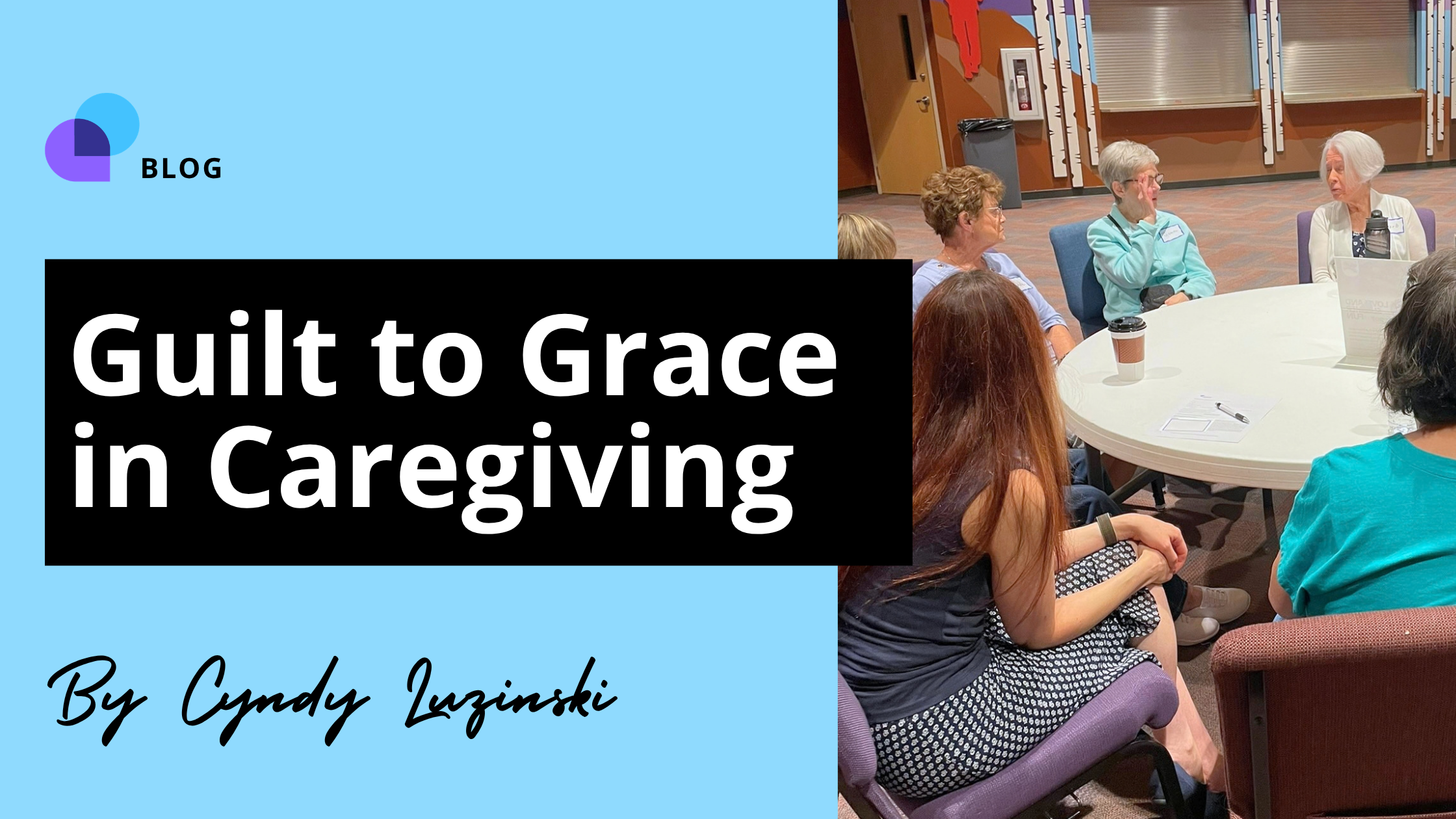
24 Sep Guilt to Grace in Caregiving
Written by: Cyndy Hunt Luzinski, MS, RN
Founder and Executive Director, Dementia Together
Married for 56 years, Marcus explained, “We are tethered. Even when I’m not with Elena, I feel the emotional tie to her, the pull to protect her and remain within her reach. I feel guilty when I’m not with her.”
In Dementia Together care partner support groups, we often hear that guilt is one of the heaviest burdens of loving someone through dementia. It shows up when we rest, when we ask for help, when we feel frustrated, or when we realize we cannot give what we once thought we could. For many, guilt becomes a quiet but constant companion.
Guilt doesn’t mean we are doing caregiving wrong. More often, it means we care deeply, we have been carrying too much alone, and our identity has been stretched beyond what any person can sustain indefinitely.
One of the hardest truths in caregiving is that love does not erase limitation. We can be devoted and exhausted. We can be faithful and uncertain. We can be compassionate and still need a break. The healing work of caregiving is discovering that we do not have to be freed from guilt to be freed through it. Growth in caregiving comes when we stop trying to silence guilt and instead learn how to transform it into grace.
Guilt often speaks in “shoulds:” “I should do more…I should not have done that…I should be more patient…I should not feel resentful…I should be able to handle this alone.” Regardless of whether the past relationship was deeply supportive or filled with hurt, caregiving stirs guilt because it disrupts identity as much as it disrupts routine. The spouse becomes the manager of the household, the finances, and the activities of daily living. The daughter becomes the decision-maker. The son becomes the advocate.
The good news? Guilt isn’t where we are stuck. It’s where grace begins.
Practical Strategies that lead to GRACE
Ground yourself in truth
Name the guilt and take every thought of it captive. When guilt surfaces, pause and identify what it is saying. Just because we think something doesn’t make it true. Not every thought that enters the mind deserves a place to stay. Some thoughts must be noticed, challenged, and replaced.
When guilt says, “You should have done more,” grace answers, “I did the best I could with what I knew at the time.”
When guilt says, “You should not need help,” grace answers, “Needing help does not make me weak; it makes me human.”
When guilt says, “You are failing,” grace answers, “I am adapting to a hard reality with love and courage.”
This is truth-telling with kindness.
Reframe the story
Shifting our focus moves us from guilt to grace.
Sometimes guilt is tangled with feelings of inadequacy and tied to the belief that if the roles were reversed, “my loved one would do a better job!” Other times, it grows from unresolved history, old wounds, or grief that never found healing. While the past cannot be rewritten, the present can still be shaped with care and intention.
Reframing means acknowledging grief, not only for what has been, but for the future we imagined that will not unfold as expected. It means realigning with our loved one’s disability and accommodating as needed. It is choosing to see what is true now rather than holding tightly to what was or what we thought should be.*
We find what we look for. When we begin to look for purpose, meaning, and even joy, we will find them, sometimes in unexpected places and unlikely moments. Where we once felt only loss, we now discover authentic connection and spontaneous humor. Shifting our focus opens our hearts to find grace.
Accept and ask for help
Guilt grows in isolation. Share one concrete piece of the load.
Care partners are often told, “take care of yourself,” but without concrete support, that advice can feel unrealistic. Still, self-care is not abandonment; it is stewardship. Those who never step away are not more faithful; they are often just more depleted.
We can invite someone to sit with our loved one while we run an errand. We can accept a meal. We can let someone take a walk with our loved one while we rest. When we give others the gift of serving, something changes. Our burden becomes shared, and guilt begins to loosen its grip, making room for grace. Sharing care does not diminish our love; it strengthens our sustainability.
Create space apart to come together again
Healthy love sometimes needs distance.
With sustainability in mind, we can step away regularly, even briefly, to rest, think, or reconnect with whom we are beyond caregiving. Then we return. This rhythm, moving apart and coming back together, helps our loved ones adjust to others and helps us re-engage not just as caregivers, but as spouses, children, or siblings.
When we offer explanations that make sense to our loved ones, this rhythm replaces constant nearness with intentional presence and often helps reduce guilt in the process.**
Engage the present moment
Much of caregiving guilt comes from replaying the past or fearing future regret.
In any situation, there is power in asking, “What is the most loving thing I can do right now?” “What does love require of me in this moment?”
The most profound differences are often made through the smallest choices—offering eye contact, a smile, a hand, a song, or a snack instead of words that may only confuse or overwhelm.
The smallest choices often hold the deepest grace. For Marcus, after a lifetime with Elena (once two young graduate students building a life together through poverty, love, and shared grit), this truth continues to unfold. Marcus is learning that questions, contradictions, and detailed information are not helpful. Words, once so natural between them, are no longer what she needs most. Now, it is in the quiet choice to give Elena a hug, that Marcus finds his bride again and grace appears.
From GUILT to GRACE.
If you are carrying care partner guilt today, name one thought that needs grace, one burden that can be shared, and one small act of care you can offer yourself before the day ends.
Much of this reflection has centered on the guilt we place on ourselves. But some guilt comes from outside voices that question our choices or suggest that loving sacrificially is somehow misguided. Care partners are wise to recognize when outside voices do not honor the sacred commitment they are trying to protect. It can be a tricky balance to trust their own discernment in caring for the person they know best and love most, while humbly considering guidance from advisors who respect the autonomy and overall well-being of everyone involved. Every caregiving journey unfolds differently, and loving faithfulness will not look the same for everyone.
Caregiving can be both a privilege and a strain. It is an expression of love, commitment, and a sacred calling. Making room for even one relationship, one interest, or one part of our identity outside caregiving is not selfish; it is stewardship. Making space for what is life-giving strengthens us to keep showing up with tenderness, while also preparing us with purpose for the season ahead, when caregiving will no longer define daily life. In the sacred tension of caregiving, grace reminds us that caring well and caring sustainably are not opposing truths—they belong together.
Grace also embraces repetition of what works and what matters, so to repeat the steps on the pathway from guilt to grace:
Ground yourself in truth: Not every thought that enters the mind deserves a place to stay.
Reframe the story: We find what we look for.
Accept and ask for help: Sharing care does not diminish our love; it strengthens our sustainability.
Create space apart to come together again: This rhythm replaces constant nearness with intentional presence.
Engage the present moment: The smallest choices often hold the deepest grace.
In taking these steps on the pathway from guilt to grace, may you notice support, connection, perspective, and growth. Evidence of grace that’s been there all along.
*Evidence-based research shows that care partners who apply Dementia Together strategies experience less stress and greater efficacy (purpose and meaning) in caregiving. This aligns with previous findings from the Contented Dementia Trust in England, where those using the SPECAL® Method, a framework informing Dementia Together education and support, also report reduced guilt.
**Who you choose for your care team matters. Select people trained in Dementia Together strategies for lifelong well-being. True respite means freedom from guilt and comes when those supporting your loved one know how to protect and sustain well-being.
