


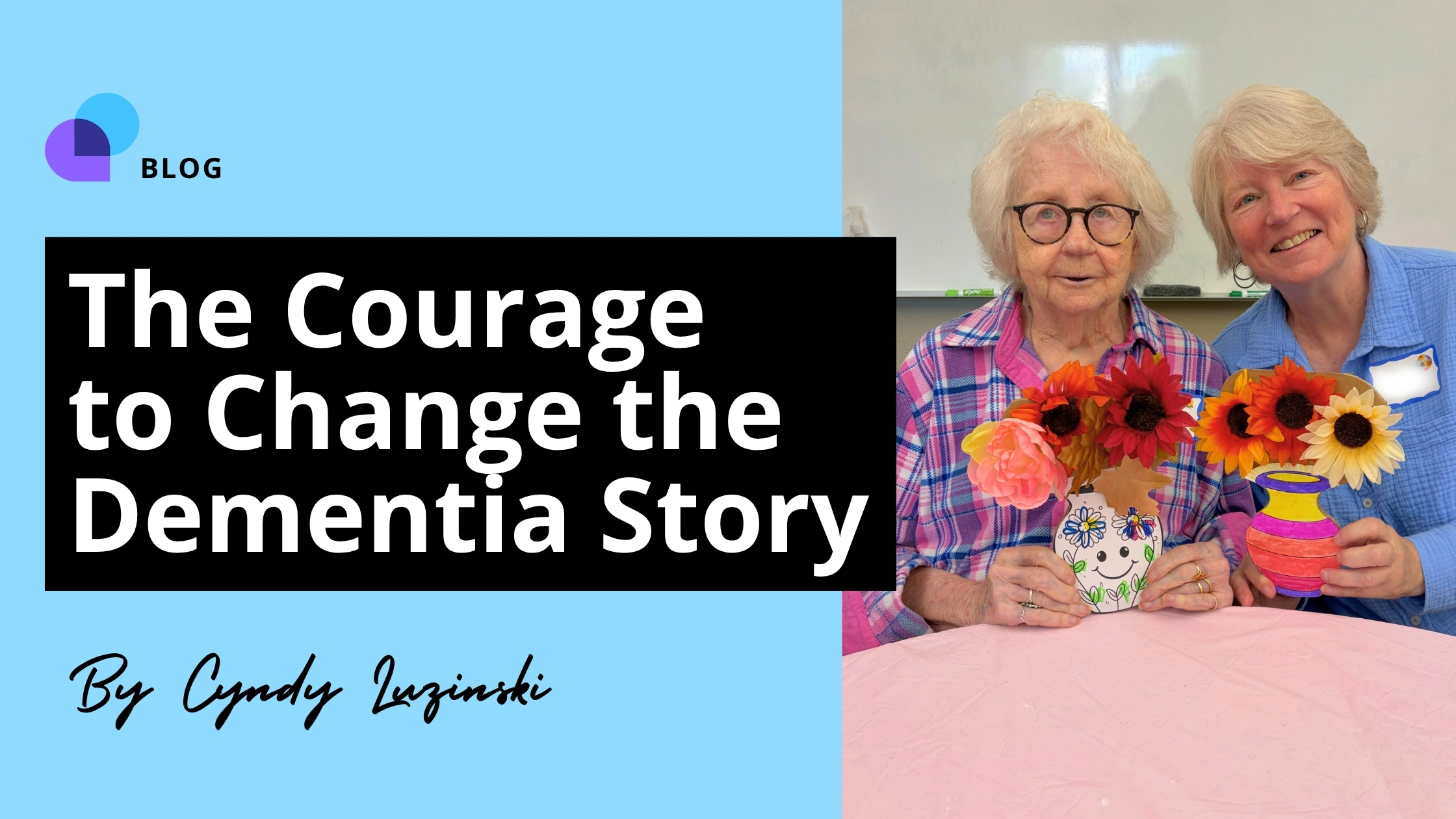
27 Aug The Courage to Change the Dementia Story
Written by: Cyndy Hunt Luzinski, MS, RN
Founder and Executive Director, Dementia Together
At a recent support group gathering, care partners discussed one of the hardest decisions they face: when—and whether—to tell others that someone they love is living with dementia.
A spouse, parent, or friend may initially say, “Please don’t tell anyone.” That request often comes from fear of being treated differently, losing respect or independence, or being defined by a diagnosis. In a culture that too often portrays dementia only as tragedy and loss, that fear makes sense.
But silence can become isolating. When others do not understand what is happening, they may misinterpret changes, pull away, or fail to offer help simply because they do not know.
Sharing a diagnosis is never a one-size-fits-all decision. Every family must consider the dignity and well-being of the person living with dementia. Yet, when care partners are ready to share their story, something powerful can happen. Friends, neighbors, coworkers, faith communities, and extended family often want to help—they simply need to know how.
Care partners become advocates and protectors of the person they love, as well as educators and guides for those around them. By helping others respond with tangible support, they create a safer, more connected world. That is where stigma begins to lose its power.
Silence Protects Stigma
Stigma thrives when dementia remains hidden, feared, or misunderstood. It grows when people assume a diagnosis means life is over, meaningful connection is gone, or distress is inevitable.
At Dementia Together, care partners are helping change that story. Every time someone says, “My husband is living with dementia, and we are still finding ways to live well,” they challenge the tragedy narrative. Every time a family invites a neighbor to learn, gives a friend a practical way to help, or speaks honestly about both grief and joy, understanding grows.
Dementia is not easy. But it is not only loss.
One care partner recently told his Dementia Together support group friends, “I experienced grace on this journey when I realized it’s not all loss. It’s emergence and discovery that the essence of my beloved wife is still there. I just needed to be the one to find her.” The person is still there. The relationship can still hold meaning, connection, contentment, and even joy.
“Common Sense” Is Not Enough
Changing stigma requires more than open conversation. It requires changing how we respond to dementia. “It’s the DOING that makes the difference…” This is why our classes and workshops are called Doing Dementia Together™.
Too often, senior-care and health-care professionals assume they already know what to do. They may bring years of experience, advanced degrees, clinical expertise, and the best intentions. Yet many have been taught to view dementia-related distress, confusion, and conflict as unavoidable—something to endure, manage, “distract” from, or control.
Experience and good intentions alone do not guarantee care that supports lifelong well-being. If they did, anti-anxiety and antipsychotic medications would not so often become the default response when a person living with dementia communicates distress.
Traditional approaches often rely on logic, reassurance with facts, or “redirection,” expecting the person living with dementia to adapt to a world that no longer makes sense. Well-intentioned but ineffective, these strategies miss the real issue: we often try to redirect the wrong person. Doing Dementia Together™, grounded in the framework of the SPECAL® Method, offers a better way.
Rather than expecting the person living with dementia to understand or comply, our strategies equip care partners and professionals to adapt their own approach with greater understanding and skill. The responsibility belongs with those of us providing support: to accommodate the disability and respond to feelings rather than rely on facts that may no longer store reliably.
Hope is in the Care
Until there are cures, hope cannot be reserved only for a future breakthrough. Hope must also be found in current care—in the words we choose, the expectations we challenge, and the relationships we protect.
People living with dementia deserve more than fear, labels, and assumptions. Care partners deserve practical tools that replace exhaustion and helplessness with confidence and connection. Professionals deserve education that goes beyond diagnosis and medical terminology to provide strategies that truly change daily practice.
One nurse who completed our online education shared, “I wish I had learned this sooner. I’ve been a nurse for many years, but no other dementia education has been this insightful or practical. I realized that questions I thought were engaging my clients were actually causing unnecessary anxiety. This has helped me improve the care I give.”
We invite senior-care and health-care professionals to stay humble, curious, and willing to learn—even when years of education and experience have taught them, “This is just how dementia is.”
Perhaps it is how dementia is when we continue using the same approaches long accepted as standard practice. But it does not have to be that way. When we adapt to the disability rather than expecting the person living with the disability of dementia to adapt to us, we reduce stress, strengthen connection, and make living well with dementia the expectation—not the exception.
Discover with us: what is good for dementia is good for the world. Learn more: dementiatogether.org
