

29 Jul Care Partners: We’re Redirecting The Wrong Person
Posted at 08:07h
in Blog
While scientific research continues to search for medical treatments and cures for the many causes of dementia, families are striving to live well on this journey now. For them, real hope is not only found in a future breakthrough, but in the quality of care, understanding, and support they give and receive today. At Dementia Together, we recognize family members as what they truly are: care partners, not cure partners.
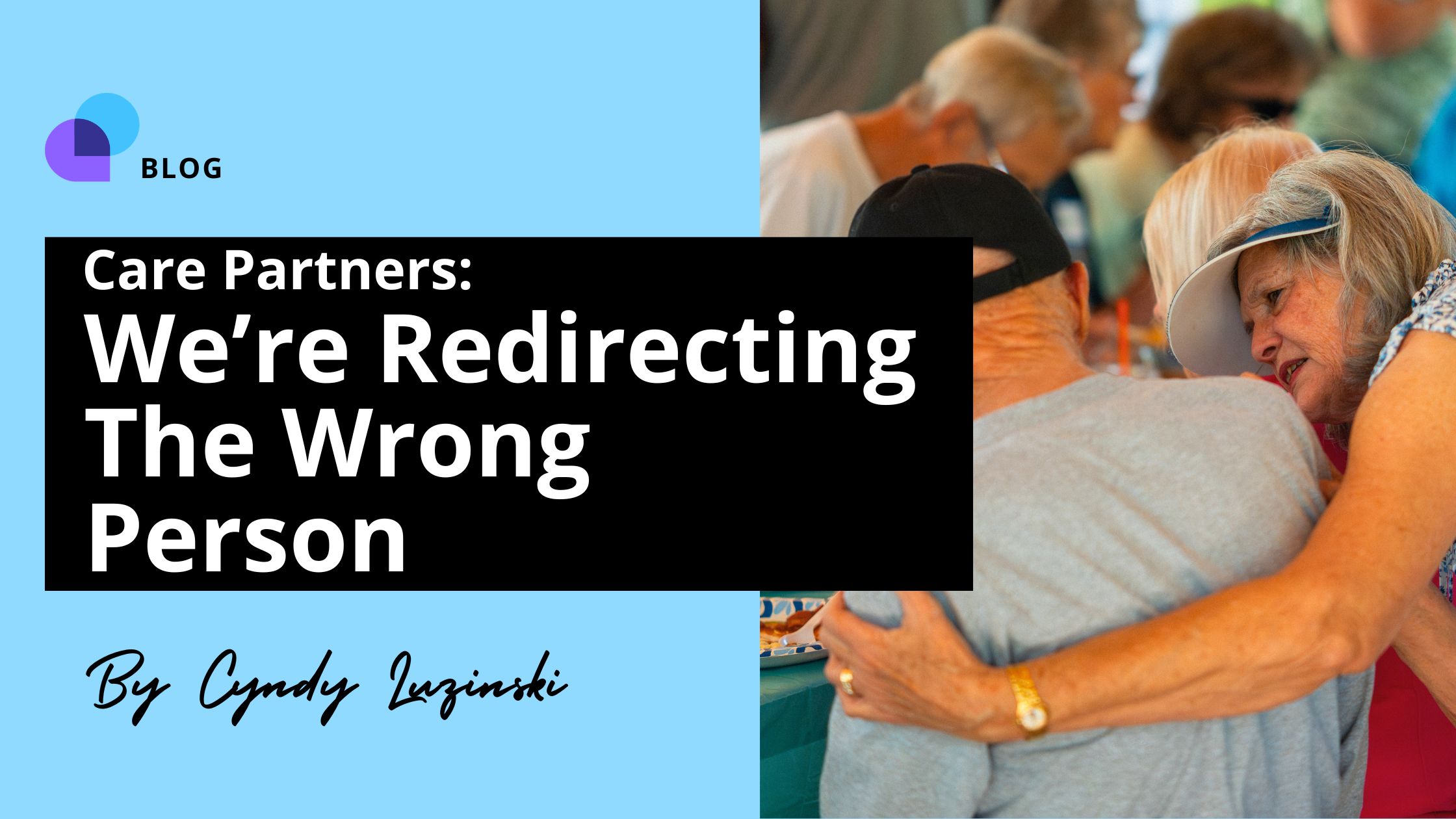
Being a care partner means shifting who we redirect. Too often, people in caregiving roles instinctively look to the person with dementia to behave differently. Meaning well, care partners may try to redirect to something different, hoping to prompt the person living with dementia to “remember,” comply, or get “distracted” with something else. That expectation is unhelpful because it asks someone with cognitive challenges to correct a disability beyond their control.
At Dementia Together, we challenge the status quo and current dementia care assumptions with the realization that it is not the expert living with the disability who needs to be redirected. Instead, care partners are often the ones who need to redirect their own approach.
We are privileged to help families learn that dementia is best managed by treating the condition as a simple disability that causes recent facts to no longer store reliably, while feelings continue to store the same way as usual. People with dementia still feel loved, safe, frightened, joyful, sad, or embarrassed. Family members who respond with the communication strategies we teach, recognize that feelings become more important than facts. This helps them meet their loved one’s emotional needs more effectively. They avoid disturbing what makes sense to their expert (the person living with dementia) based on what recent factual information is no longer storing. As a result, agitation and anxiety often decrease.
Effective dementia care is not about medical terminology, complex diagnostics, or understanding every pathophysiological pathway impacting cognition. The medical model has too often left families without hopeful answers, and in the absence of cures, all roads seem to lead to antipsychotics or anti-anxiety medications. But dementia care is not only about managing symptoms. It is about meeting human need. It is about practical, counter-intuitive shifts anyone can make to promote lifelong well-being.
For example, when a loved one insists on going home to a place they no longer live, the typical correction, “This is your home now,” often escalates distress. A care partner might instead start with, “You want to go home. Of course you do.” Dementia Together care partners learn to give the feeling of home without actually going to another location. They understand that home is a feeling. Home is where everything makes sense. No one asks to go home when they feel at home. Rather than trying to redirect the person who wants to go home, we need to redirect those around them to create the feeling of home in the meantime–until they can get “home” to a place where everything makes sense. That simple redirection acknowledges the feeling for the expert, reduces fear, and restores dignity. (You can learn more on how to create the feeling of “home” in our workshops.)
Dementia Together also works alongside other like-minded pioneers to redirect the system of dementia care. Too often, checklists and credentials do not change the way staff respond when anxiety later in the day is assumed to be “inevitable,” “normal,” or simply labeled as “sundowning.” Most professional training programs and organizational systems place too much emphasis on certifying knowledge about dementia, while giving less attention to the repeated, practical use of strategies that actually improve daily life for people living with dementia.
Dementia Together is changing that narrative. We want to move beyond “checking the boxes” to meet training requirements and accumulate certifications and instead focus on the real work of applying effective strategies—becoming highly skilled in what truly supports lifelong well-being for people living with dementia.
What transforms daily life are small, repeatable practices that change interactions in the moment. At Dementia Together, we share simple, practical tools and strategies for care partners, professionals, first responders, and our community to apply immediately. Care is something we do with people, not to them. The Dementia Together Response Scale™ helps those caring for a person with dementia discover whether to repeat what works or release what doesn’t, readjusting to something better as needed.
In the face of the typical cultural tragedy narrative, we’re known for saying, “It doesn’t have to be that way.” This is the heart of what we teach at Dementia Together. Small changes in how care partners respond can change the whole day. By catching the clues the expert gives us, choosing curiosity over contradiction, connection over confrontation, and care over correction, we learn to redirect ourselves. That is how hope moves from “someday” to “now.”
Learn more of these immediate implementable strategies in our Doing Dementia Together™ classes and workshops for families, or if you are a professional caregiver, check out our online educational platform. Dementiatogether.org.
